Direct reaction and future spectrometer at HIAF

→Asia/Shanghai
Institute of Modern Physics, CAS, Huizhou, China
Description

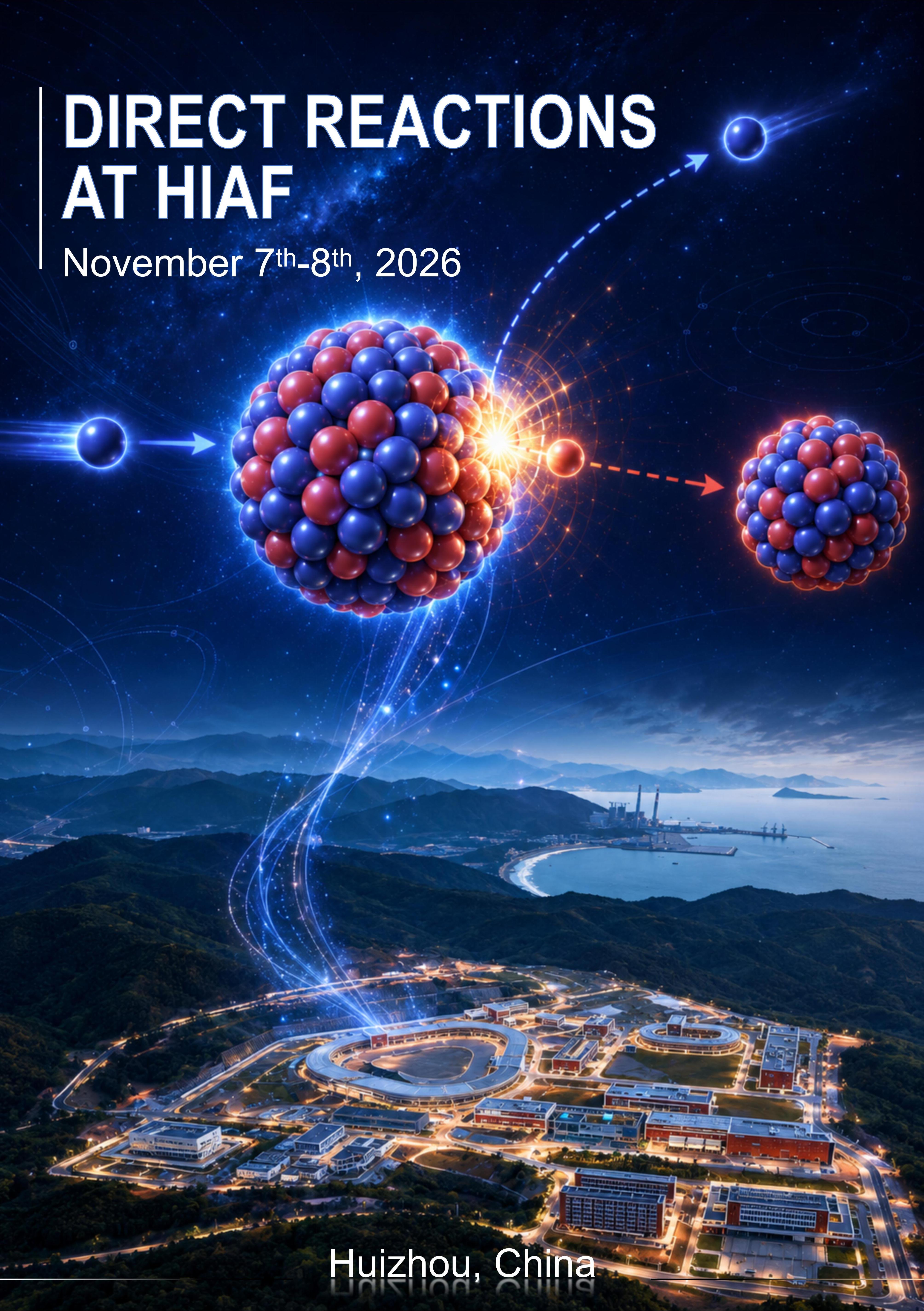
The High Intensity Heavy-ion Accelerator Facility (HIAF) has completed its construction. Equipped with an advanced accelerator complex and a next-generation in-flight separator, HIAF provides an excellent platform for a wide range of experiments utilizing direct reactions. As an international user facility, HIAF warmly welcomes scientists from around the world to participate in its scientific programs.


Spectrometers play a pivotal role in direct reaction studies by enabling precise momentum analysis of outgoing reaction products, which is essential for both missing-mass and invariant-mass spectroscopy. To expand these capabilities, a dipole-magnet-based, large-acceptance spectrometer is planned at HIAF. Presenting these scientific opportunities to the broader community and gathering community input are vital steps in shaping the facility's roadmap. This workshop serves as the launchpad for the spectrometer's design phase, where contributions from researchers across diverse fields will be critical.


Following DREB 2026, this satellite workshop will bring together theoretical and experimental researchers to discuss recent progress with spectrometers and future perspectives in direct reaction physics. Discussions will focus on physics opportunities at HIAF, alongside the conceptual design, physics cases, and development plans for the future HIAF spectrometer.

Main Topics

• Direct reactions at HIAF and physics opportunities
• Experimental techniques and reaction theory
• Conceptual design and status of the future HIAF spectrometer
• Detector technology and instrumentation for direct reaction studies
• Future perspectives and international collaborations at HIAF

The program will take place from November 7 to 8, 2026, with participant registration on November 6. The presentation sessions and collaborative discussions will be held on November 7, followed by a guided tour of the HIAF facility on November 8.

Tentative Schedule
  • November 6, 2026:Participant registration
  • November 7, 2026:Workshop presentations and collaborative discussions
  • November 8, 2026:Guided tour of the HIAF facility

  • Saturday 7 November
    • 1
      Opening
      Speaker: He Wang
    • 2
      Considerations on Direct Reaction and Spectrometer at HIAF
      Speaker: He Wang
    • 3
      Intronduction on R3B
      Speaker: Marina Petri(University of York)
    • 4
      Direct reactions theory
      Speaker: Gregory Potel Aguilar(University of Seville)
    • 10:10
      Coffee break
    • 5
      Introduction to HRS
      Speaker: Daniel Bazin(FRIB/MSU)
    • 6
      Introduction on Grand Raiden
      Speaker: Juzo Zenihiro(Kyoto University)
    • 7
      Introduction to SHARAQ
      Speaker: Nori Aoi(CNS, University of Tokyo)
    • 11:45
      Lunch
    • 8
      Facility tour
  • Sunday 8 November
    • 9
      Introduction on RAON-LAMPS
      Speaker: Cheongsoo Lee(IRIS, Institute for Basic Science)
    • 10
      Neutron detectors
      Speaker: Siwei Huang
    • 11
      Spin Teleportation of Protons at the MeV Scale
      Speaker: Dong Bai
    • 12
      CIAE Q3D simulation
      Speaker: Zifeng Luo(Institute for Basic Science)
    • 10:20
      Coffee break
    • 13
      Introduction on LISA
      Speaker: Kathrin Wimmer(University of Cologne)
    • 14
      Reaction study at HIAF
      Speaker: Yelei Sun(Beihang University)
    • 15
      Exotic Phenomena in Open Quantum Systems
      Speaker: Simin Wang(Fudan University)
    • 16
      Introduction to HYPATIA
      Speaker: Marina Petri(University of York)
    • 12:10
      Lunch
    • 17
      Introduction to CIAE Q3D
      Speaker: Lei Yang(China Institute of Atomic Energy)
    • 18
      Theory of spectroscopy and reactions in deformed nuclei
      Speaker: Andrea Idini(Lund University)
    • 19
      Studying Isospin Symmetry Breaking in A=29 Tz=±1/2 Mirror Isotopes
      Speaker: Yiyi Zhu(TRIUMF)
    • 15:10
      Coffee break
    • 20
      Introduction on SAMURAI
      Speaker: Yuki Kubota(RIKEN Nishina Center for Accelerator-Based Science)
    • 21
      Understanding effect of tensor interaction in nuclei via high-momentum nucleon-transfer reactions
      Speaker: Hooi Jin Ong(IMP)
    • 22
      Weakly bound p-rich isotope interactions with light targets
      Speaker: Uiran Umbelino da Silva(Institute of Physics - University of São Paulo)
    • 23
      Closing
      Speaker: He Wang
Baidu
map